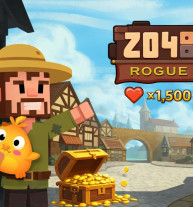
2048 Rogue feels like a familiar puzzle game - but after a few moves, you realize it’s playing by different rules. It takes the classic merging system and adds pressure, randomness, and long-term strategy, turning every session into a run where survival matters just as much as your score.
Inspired by 2048, 2048 Rogue keeps the core mechanic of sliding tiles and merging identical icons. But instead of focusing only on reaching a high number, the game pushes you to manage space carefully and think several steps ahead.
Each move shifts the entire board and spawns a new tile, meaning one bad decision can quickly fill your grid and end your run.
The controls are simple, but the strategy runs deep. You use the arrow keys to move all tiles in one direction. When two identical tiles collide, they merge into a stronger form.
Here’s what you’ll need to manage:
Limited space on the board
Random tile spawns after each move
The risk of blocking your own paths
Long-term positioning for bigger merges
If the board fills up and no moves remain, the game ends—so every move counts.
One of the most noticeable changes in 2048 Rogue is its visual style. Instead of plain numbers, tiles evolve into creatures and objects as you merge them. Watching these transformations unfold adds personality to the game and makes progression feel more rewarding.
It’s a small change, but it makes each merge more satisfying than in traditional versions.
2048 Rogue goes beyond the standard endless mode by offering multiple ways to play:
Endless Mode – Focus on survival and high scores
Story Mode – Progress through structured levels with light narrative elements
There’s also an undo feature, which gives you a second chance after a bad move. It’s especially useful when you’re experimenting with new strategies.
For competitive players, a global leaderboard lets you compare your performance with others and aim for higher rankings.
The roguelike influence changes how you approach the game. Instead of playing casually, you start planning moves more carefully, thinking about how each action affects your future options.
Every run feels slightly different due to:
Random tile placement
Changing board layouts
Strategic decisions that shape your path
This unpredictability keeps the game fresh, even after multiple attempts.
If you want to improve your performance in 2048 Rogue, try these:
Keep your strongest tiles in one corner
Avoid scattering tiles across the board
Plan at least 2–3 moves ahead
Use undo wisely instead of relying on it
Focus on creating space before chasing big merges
2048 Rogue successfully turns a simple puzzle concept into a more strategic and replayable experience. It keeps the accessibility of classic 2048 while adding enough depth to challenge even experienced players.
If you enjoy puzzle games that reward planning and smart decision-making, this is a great one to add to your rotation. Just be prepared—once you start a run, it’s hard to stop.
There are many other games developed under Wordle NYT, let's try them out